Win your inventory.
Free the cash on your shelves and stop losing sales to empty ones. NextDemand forecasts demand for every item — steady sellers and slow, lumpy movers alike — and turns it into money decisions: what to order and when, in time for your supplier's lead time; which overstock to sell down; and where you need a second supplier. Right where Excel and your ERP's min/max fall short.
Bilingual English · עברית — Works from a CSV / ERP export today; Priority connector planned
$142K
cash frozen above real demand
$38K
est. sales missed at the spikes
Illustrative — invented figures for one year of a spare-parts catalog run on ERP min/max. Two separate amounts, never added together.
Straight from the live demo
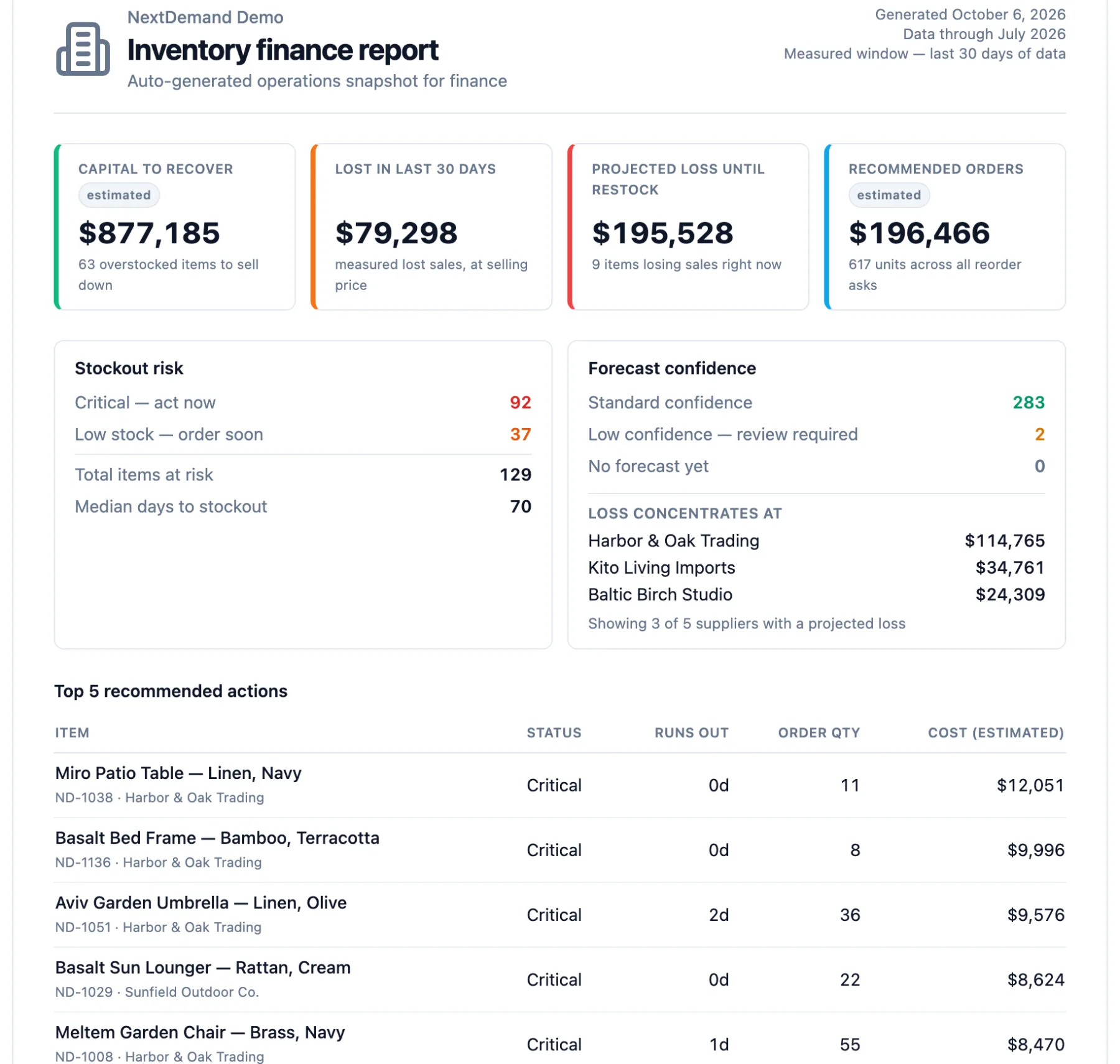
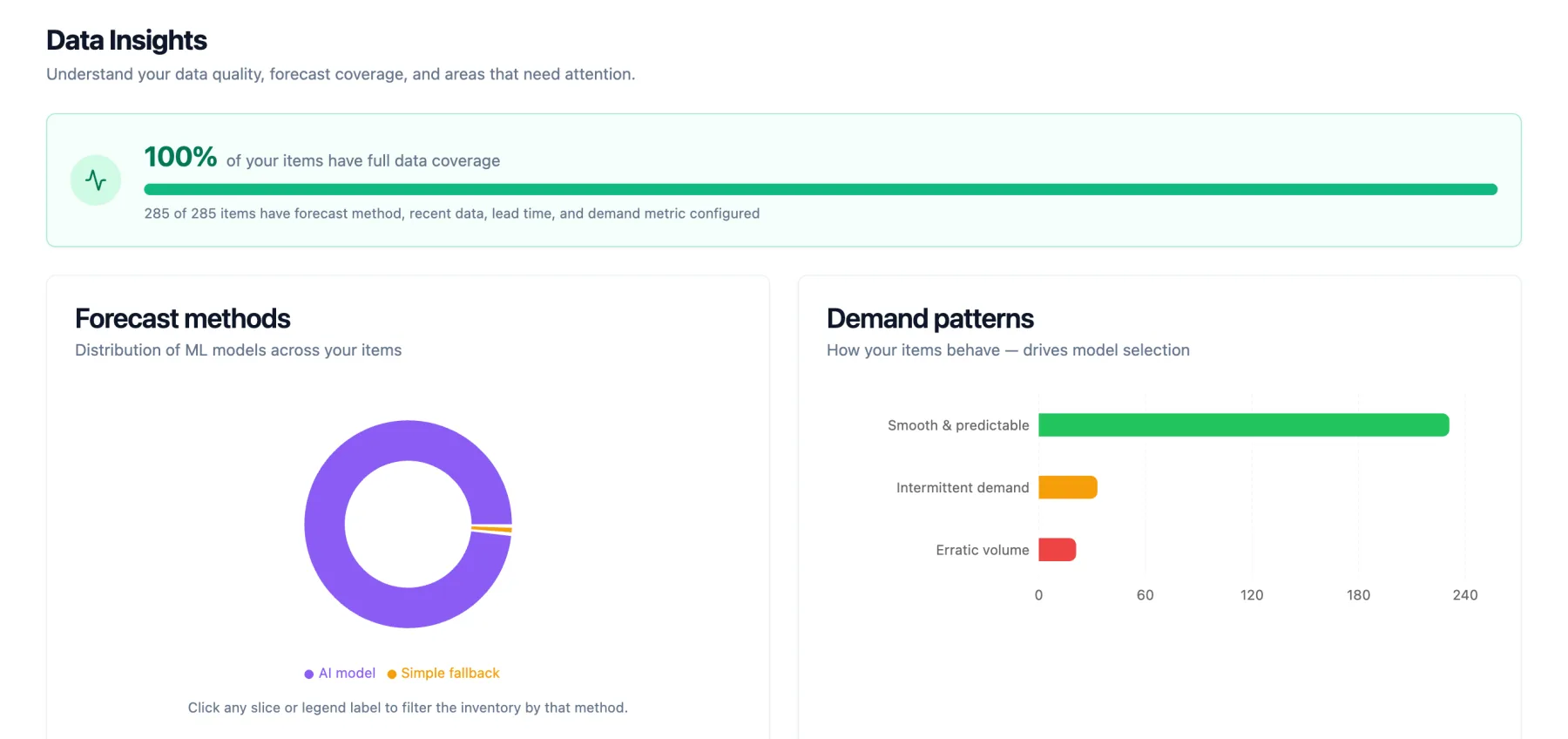
NextDemand finds the money in your inventory: cash asleep on the shelf, sales lost when you run out, orders placed too late for your lead time, and suppliers you depend on too much. These screens come from our demo company — a furniture retailer with 285 items and 8 suppliers. Every figure is computed by the product, not typed in.
The demo company, its products and its suppliers are fictional. Any resemblance to real businesses is coincidental.
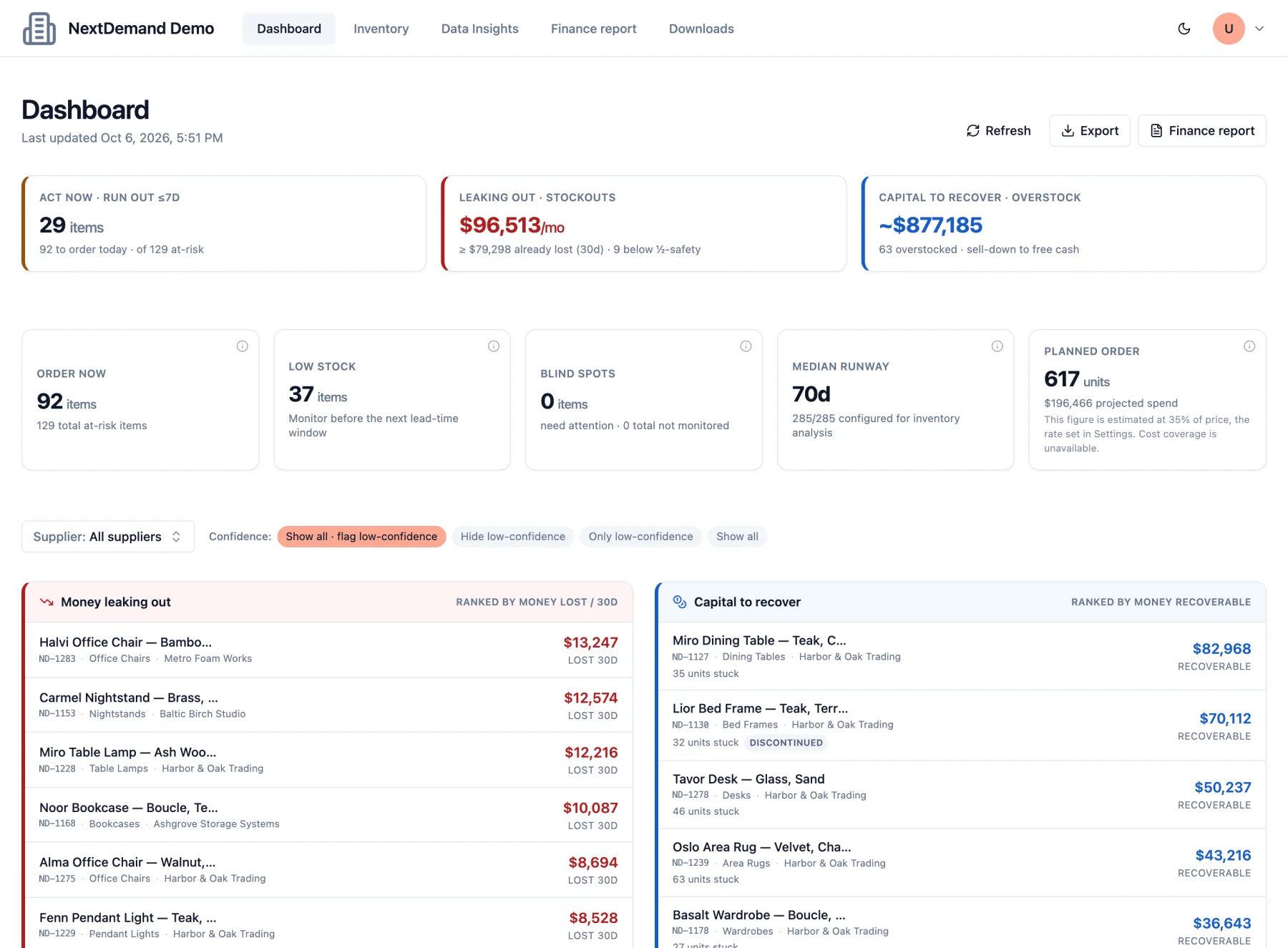
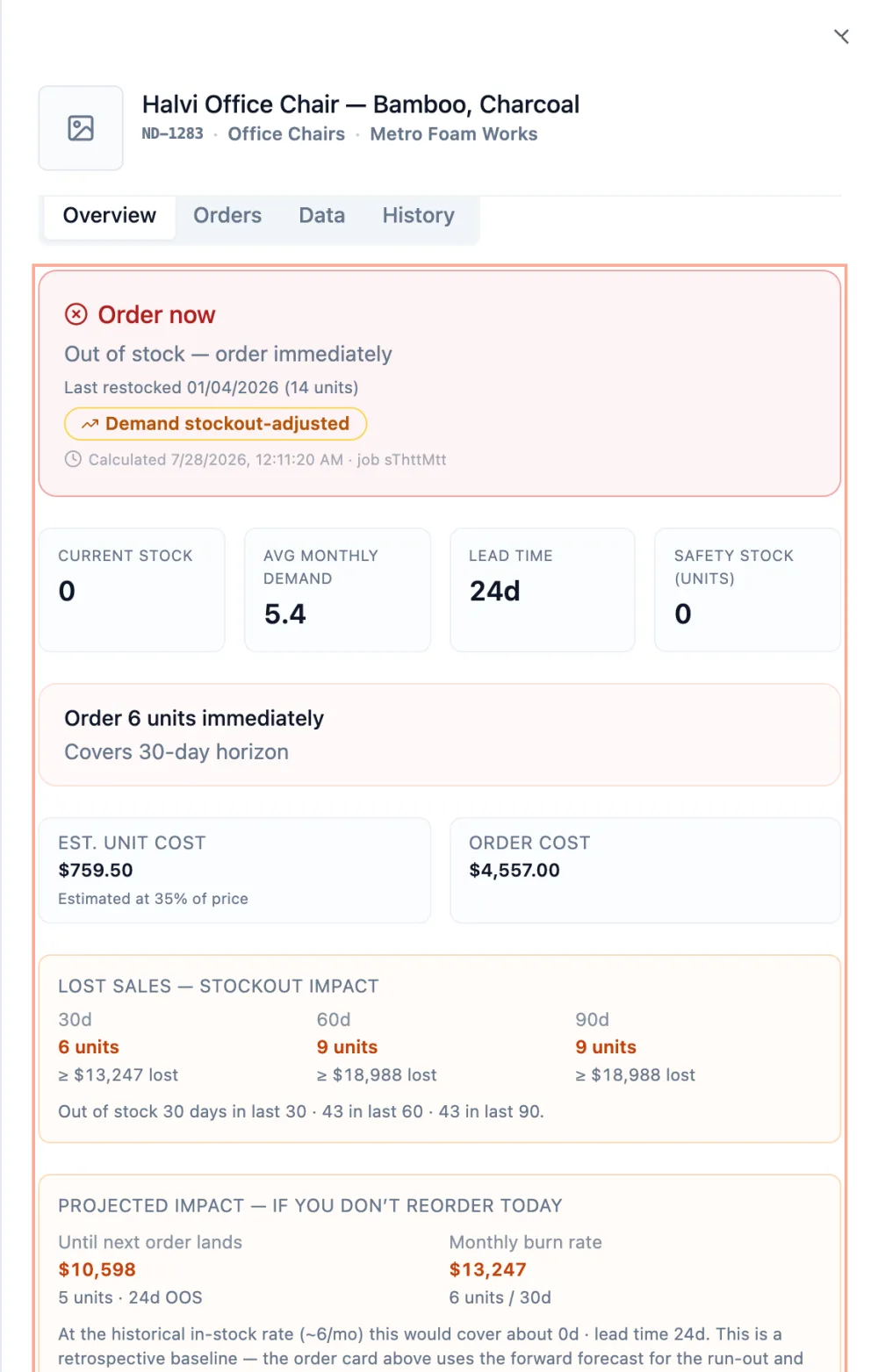
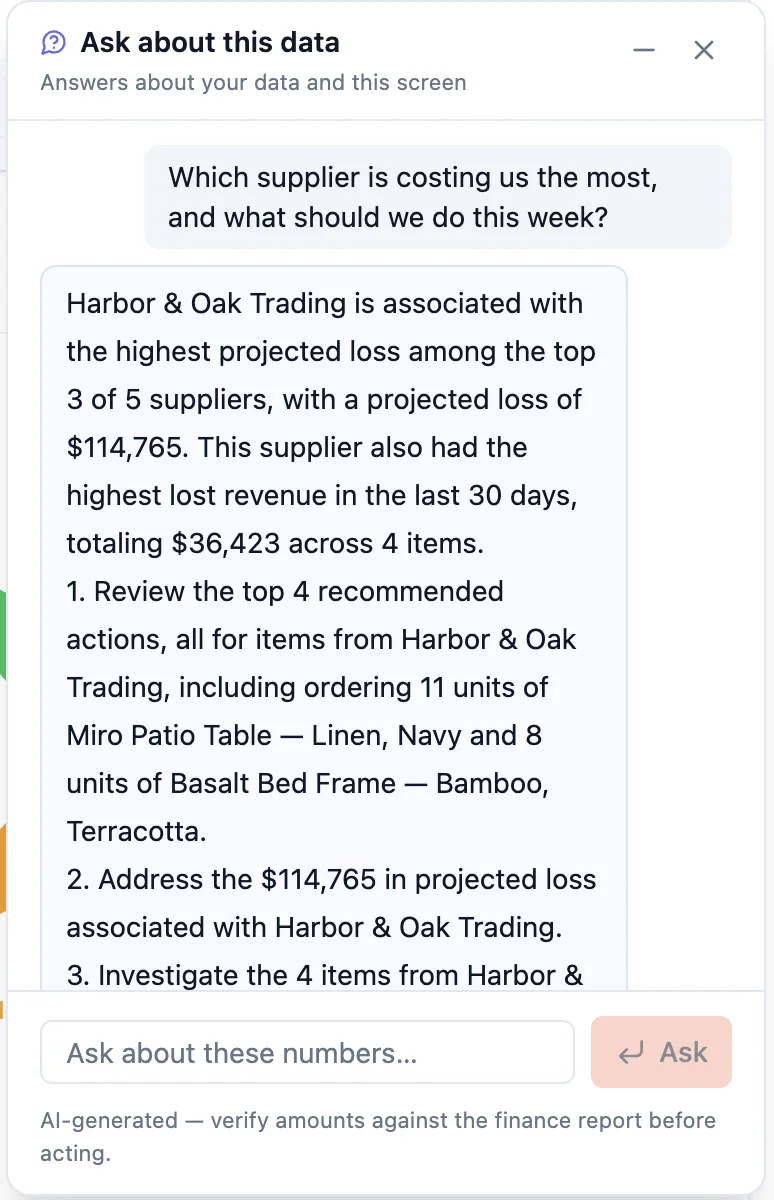
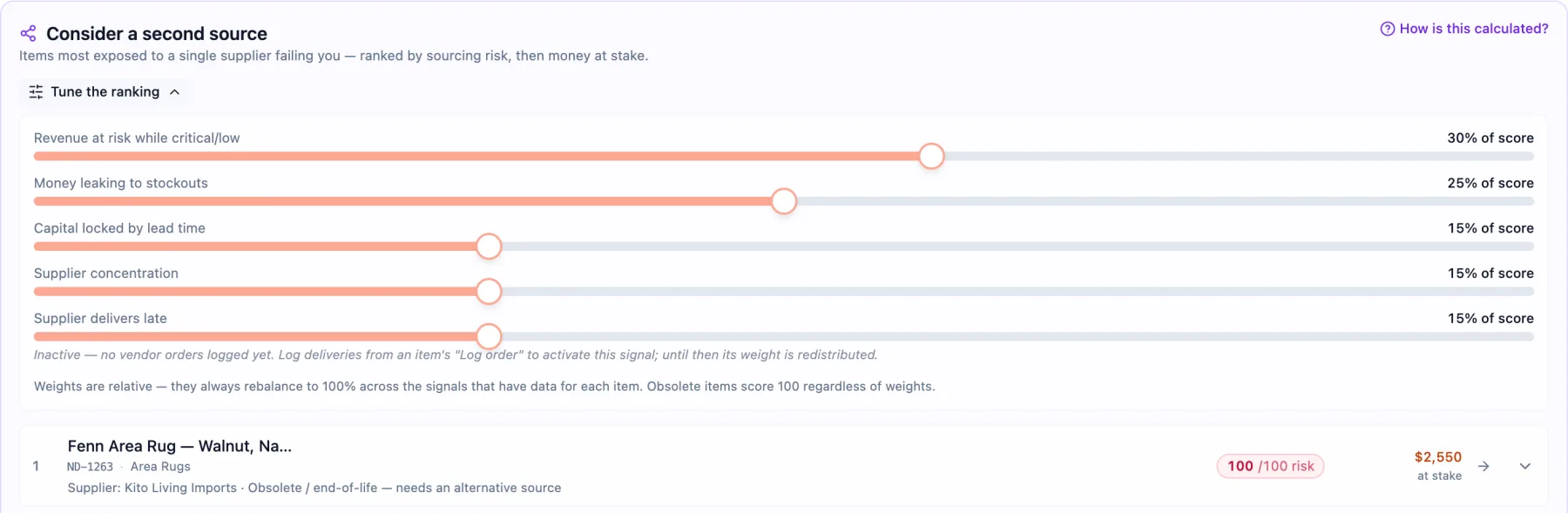
Spare-parts demand isn't a smooth line. Your tools assume it is.
Long quiet stretches, then a sudden spike. Classic min/max and moving averages over-stock the slow movers and still miss the surge — cash sits frozen on the shelf while the one part you need is out.
22%
of MRO inventory has sat unused for more than five years
SPARETECH survey of 300 manufacturers, 2025
20–30%
of an item's value is the yearly cost of just holding it in stock
Industry estimates — NetSuite, ISM, 2023–2025
20–30%
inventory reduction is achievable with AI-enabled demand forecasting
McKinsey & Company
“Too much of the wrong stock — and never the part I actually need.”
Built for businesses with many parts and lumpy demand
Distributors & importers
You sell many parts
Thousands of SKUs going out to the shops and assemblers who need them now. Win the sale without drowning in long-tail dead stock.
Auto parts · bearings · fasteners · hydraulics · electrical · plumbing
Manufacturers & assemblers
You buy & assemble many parts
Deep bills of materials with thousands of components. Never let one missing low-cost part stop a high-value build.
Electronics / EMS · medical devices · machinery · agri & irrigation
Forecasting that turns inventory back into money
01
Demand-pattern classification
Every item is automatically sorted by how it really behaves — steady, erratic, or slow and sporadic — so each gets the treatment it needs.
02
The right method for each item
Proven statistical techniques for slow, sporadic movers and machine learning where there's real signal. Established science, not a black box — the field's classics go back to Croston's method, 1972.
03
Reorder, safety stock & stockout dates
A clear recommended order quantity, when to place it, and the projected stockout date — item by item.
04
Triage by money
Items ranked by estimated missed revenue and by the stock you could release, so you know what to act on first.
05
Accuracy you can check
Shows forecast accuracy for each item, so you can trust a forecast — or challenge it.
06
Your data, your way
Works from a CSV / ERP export today; Priority connector planned. Bilingual English/Hebrew, RTL-native.
Specialist-grade forecasting, without the enterprise project
Enterprise specialists
Syncron, PTC Servigistics and the like model spare parts well — but they are built for large enterprises, with enterprise-scale roll-outs.
Spreadsheets & ERP min/max
Free and familiar — but it's the wrong math for lumpy demand, so it quietly over- and under-stocks every month.
NextDemand
Spare-parts-grade forecasting for mid-sized importers and distributors, starting from a CSV — Hebrew-native, built by a local team.
Your data stays yours — walled off, and never used to train AI
NextDemand runs on Google Cloud in a dedicated project. Here's plainly how your inventory data is protected — and how it is not used.
Built on Google Cloud
Firebase, Firestore and Cloud Run, in a dedicated Google Cloud project — not a shared server under a desk.
Encrypted in transit and at rest
Encryption in transit (TLS/HTTPS) and at rest with Google-managed keys — on the wire and on disk.
Per-tenant isolation
Every customer's data is walled off, enforced by database security rules — your catalog is never visible to another tenant.
Never sold, never trained on
Your data is yours: never sold, never shared for advertising, and never used to train AI models.
Privacy by design
How we handle personal data, and your rights under the GDPR and Israeli privacy law, are set out in our Privacy Policy.
Questions, answered
What does NextDemand do?
It forecasts demand for every item in your catalog and turns it into money decisions: what to order and when, in time for your supplier’s lead time; which overstock to sell down to free cash; how much stockouts are costing you; and where you depend too much on a single supplier.
Who is it for?
Distributors, importers, retailers and manufacturers with many items and uneven demand — from steady sellers to slow, lumpy spare parts that spreadsheets and ERP min/max rules get wrong.
Which systems does it work with?
Works from a CSV / ERP export today; Priority connector planned. You can start on a single dataset, with no rip-and-replace.
Can I try it before talking to sales?
Yes. The live demo opens a working NextDemand environment on a sample company in seconds — no signup needed.
Is my data safe? Is it used to train AI?
NextDemand runs in a dedicated Google Cloud project, encrypted in transit and at rest, with every customer’s data isolated. Your data is never sold and never used to train AI models, and AI features see column descriptions and figures, not your item names, part numbers or suppliers, which are replaced by codes. The one exception is alternative-supplier research, a premium feature on request, which can send an item’s name only with your admin’s explicit consent.
Does it work in Hebrew?
Yes. NextDemand is fully bilingual, English and Hebrew, with native right-to-left support.
Start from the data you already have
No connector and no IT project to begin: a sales-history export and your current stock are enough. Book a demo and we'll walk through your own catalog with you.
What you need, what you see
Stop losing money on your shelves.
A 30-minute demo on your own data — we'll show the demand patterns hiding in your catalog, in English or Hebrew.
yochai@nextdemand.ai