Inventory forecasting for importers with months-long lead times
When an order takes three months to arrive, a planning mistake costs a whole quarter: either the shelf is empty until the next shipment, or the warehouse fills with stock that will not move. NextDemand forecasts every item, sizes each order to its supplier’s real lead time, shows what it costs to wait, and ranks where depending on one overseas supplier puts revenue at risk.
Why importing is harder to plan
- Long, different lead times. One supplier ships in three weeks, another in four months. A single reorder rule for both is wrong for both.
- Stockouts last. Running out with an order already at sea means weeks of lost sales you cannot recover — on exactly the items customers wanted.
- Over-ordering to be safe. Buying extra "because the next shipment is far" is how cash ends up frozen in overstock.
- Concentration risk. Many importers rely on one overseas supplier for a large share of revenue — a single delay or price change hits the whole line.
How NextDemand helps importers
- Orders sized to each supplier's lead time. For every item: how much to order, by when, so it lands before the shelf runs out — using that supplier's lead time, not a company-wide default.
- The cost of waiting. Each item shows the sales projected to be lost until the next order lands, so the expensive delays get attention first.
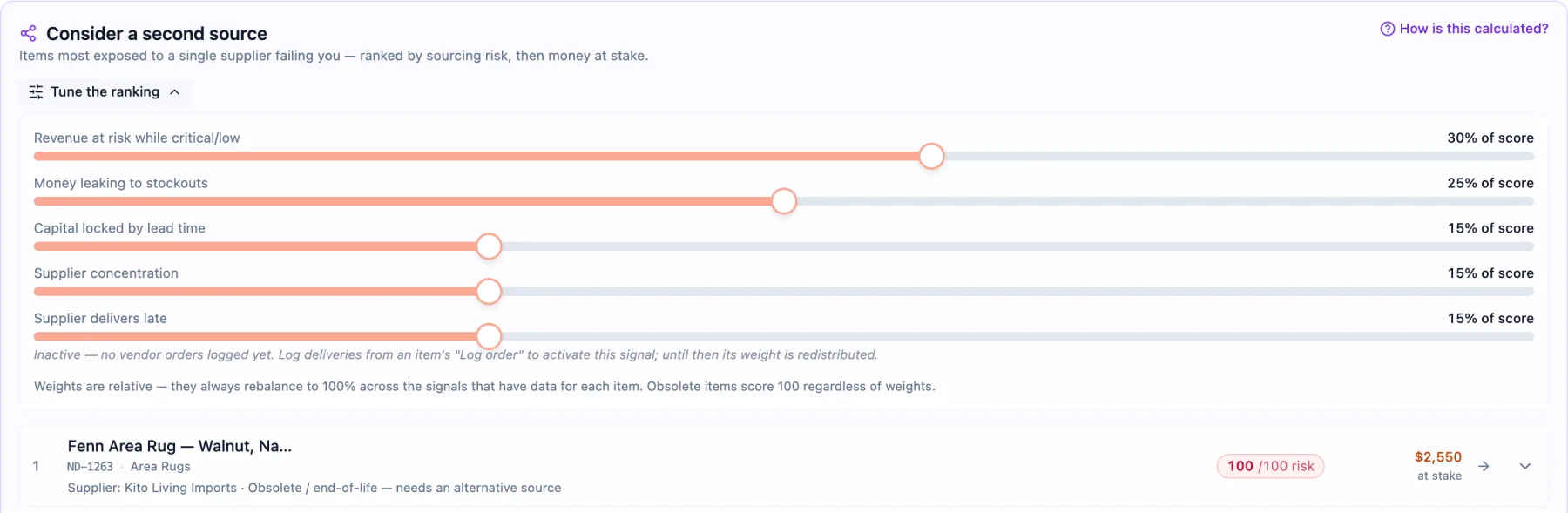
- Single-supplier risk, ranked. Items most exposed to one supplier are scored by revenue at risk, stockout losses, capital locked up by lead time, supplier concentration and late deliveries — with weights you can adjust.
- Alternative-supplier research, on request. For an exposed item you can ask NextDemand to research alternative suppliers; results come with links to their sources. It runs only when you ask, one item at a time, and only after you allow that item's name to be shared with the research model.
- Hebrew first. The product, the reports and the AI assistant work in Hebrew and English — built and supported by a local team in Israel.
What you need to start
Sales history per item, current stock, and each item's supplier with its lead time — from your ERP (Priority, SAP Business One and others) or a spreadsheet. Purchase costs add the money view. Start on a single dataset.
Frequently asked questions
How does NextDemand handle long lead times?
Each item's order recommendation uses the lead time of its own supplier, so an item that takes four months to arrive is ordered earlier — and its forecast covers that whole window — compared with one you can restock in a week.
Does it plan containers or minimum order quantities?
Not today. Recommendations are per item, sized to the forecast over the lead time; consolidating them into containers or rounding to supplier minimums stays with your buyers.
Can it find other suppliers?
On request, for one item at a time: it researches alternative suppliers and cites its sources. It sends that item's name to the research model only after you grant permission, and never sends prices, costs, stock or your supplier names.
Does it work in Hebrew?
Yes. The whole product, including the AI assistant and the finance report, works in Hebrew and English with native right-to-left layout.
See your next quarter before the ship sails
Open the live demo — a working NextDemand environment on a sample company, no signup — or book a 30-minute demo on your own data.