Spare-parts demand forecasting built for parts that rarely sell
Most spare-part SKUs sell a few times a year, in uneven quantities. Forecasts that assume steady demand order too much of some parts and run out of the critical ones. NextDemand classifies every part by how it actually sells, forecasts it with a method that fits, and turns the forecast into what to order, what to sell down, and where you depend on a single supplier.
Why spare-parts forecasting is different
In a typical spare-parts or aftermarket catalog, the bulk of the items are intermittent or lumpy: many months with zero demand, then an order of two, then one of twenty. That pattern breaks the tools most distributors plan with:
- ERP min/max and moving averages treat a part that sold 12 units once as "one a month" — so you hold stock that sits for a year, or reorder too late for the next spike.
- Safety stock formulas built on normal-distribution assumptions miss their service level on zero-heavy demand.
- Long supplier lead times mean a late order is a stockout of weeks, not days — and on a machine-down part, every one of those days is lost revenue.
The result is the familiar pair: cash frozen in parts that will not move, and lost sales on the parts customers actually needed.
How NextDemand forecasts spare parts
- Every part is classified first. Each item is labeled smooth, erratic, intermittent or lumpy using the standard ADI–CV² classification, so the method fits the part.
- Sporadic parts get sporadic-demand methods. Slow, lumpy items are forecast with statistical methods designed for intermittent demand, in the Croston family; machine learning is used where there is enough signal to learn from. Each forecast carries an accuracy score, and low-confidence items are flagged for review instead of being ordered blindly.
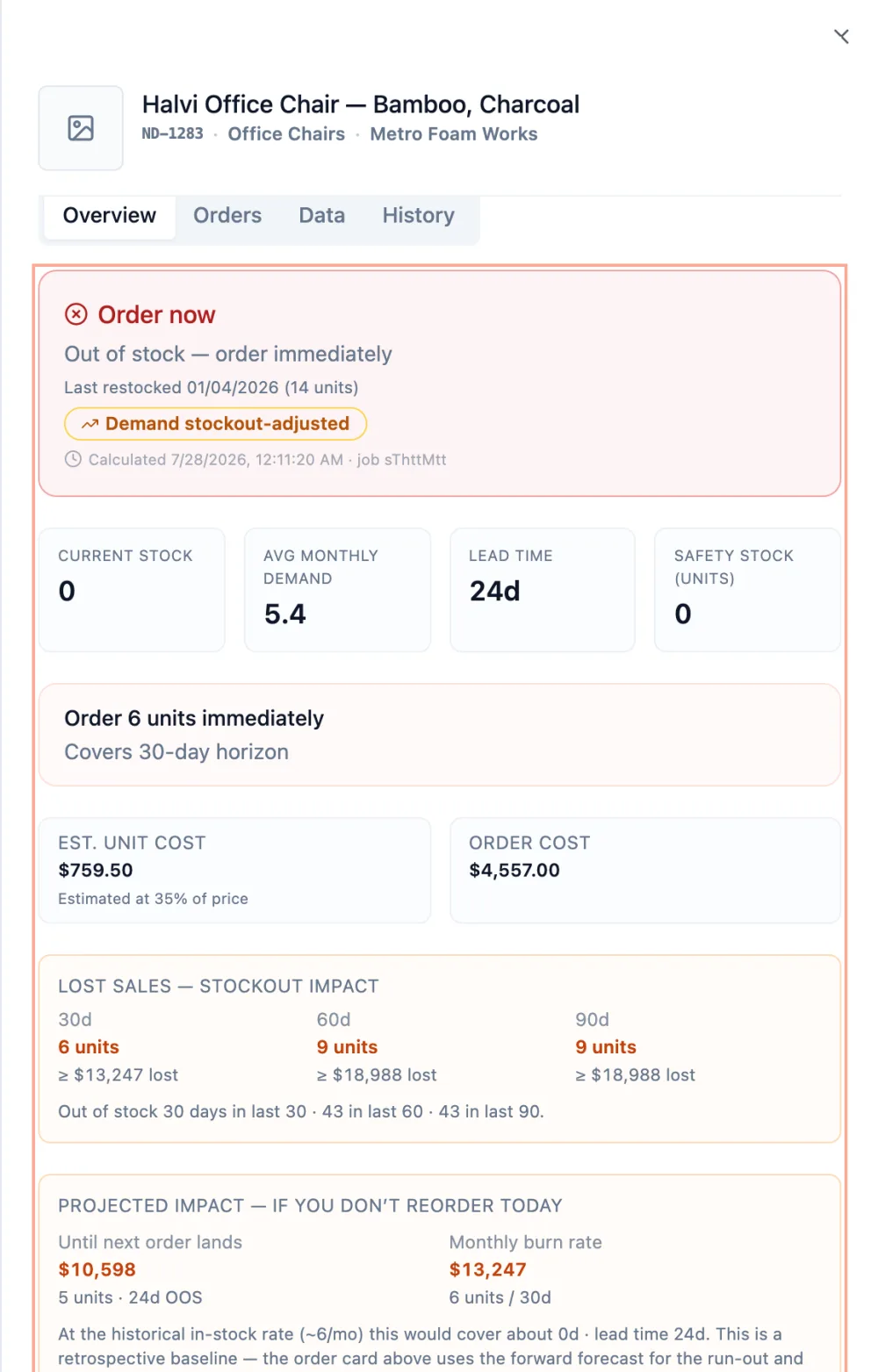
- Orders are sized to the supplier's lead time. For each part you see the recommended order quantity, when it runs out, and the projected cost of waiting until the next order lands.
- Money, not just units. The dashboard ranks parts by cash tied up in overstock you can sell down, and by sales already lost to stockouts.
- Single-supplier risk. Parts most exposed to one supplier — by revenue at risk, stockout losses and late deliveries — are ranked so you know where a second source pays off.
- Plain-language answers. Ask "which parts will run out before the next container?" and get named items and quantities from your own data.
What you need to start
An export from your ERP — sales history per item, current stock and supplier lead times — or a CSV upload. NextDemand works from exports of Priority, SAP Business One, NetSuite, Microsoft Dynamics and others, so there is nothing to install. You can start on a single dataset.
Frequently asked questions
Can you forecast parts that sell only a few times a year?
Yes. Those parts are classified as intermittent or lumpy and forecast with methods built for sporadic demand rather than with averages that assume steady sales. Where the history is too thin to trust, the item is flagged as low confidence instead of getting a precise-looking number.
Do I need to replace my ERP?
No. NextDemand reads exports from your ERP (or a CSV) and gives you the recommendations; you keep placing orders in your ERP as you do today.
How is the order quantity decided?
From the part's forecast over the supplier's lead time, its current stock, and a safety buffer — so a part with a 90-day lead time is ordered earlier and in a different quantity than one you can get next week.
Is there a version in Hebrew?
Yes. The whole product, including the AI assistant, works in English and Hebrew, with native right-to-left layout.
See it on a real catalog
Open the live demo — a working NextDemand environment, no signup — or book a 30-minute demo on your own parts data.